This volume includes works by FSU faculty, students, and alumni featuring their digital exhibition discourses and practices. Featured scholars affiliated with FSU include Ann Rowson Love, Ph.D., Annie Booth, Audrey Jacobs, Dianna S. Bradley, Hsuan Chi Liu, Yawei Xiao, Ph.D., and Zoe Hume.
Special thanks to Morgan and Zida for accepting this interview, allowing us to learn more about the formation process of this guide.
For Morgan and Zida, this connection all started with professors Ann Rowson Love and Pat Villeneuve, who introduced them to contacts at their publisher, Bloomsbury. At that time, they were working on their dissertation related to museum practices in digital settings. Morgan investigated digital programming during the pandemic, and Zida worked on a collaborative hybrid exhibition design.
“There’s a lot in there to appreciate, and what I tell everyone is you can either read it from top to bottom, or you can read the stories first, and then go back to the more academic stuff, or hop around. It’s really a practical guide in the sense that it’s to be used, not just to sit on the shelf and collect dust. So we read it, and we wrote it to be entertaining. So I hope that everyone gets to enjoy it.”
— Dr. Morgan Joseph Hamliton.
Hamilton
They originally proposed five themes to the publisher for this book: case studies, theory and practice, exhibits and programs, digital implications in galleries, and evaluation. Later, they worked with the submissions from the open call, interweaving featured works that can serve as the most valuable references for museum practitioners.
During the review process, they received practical feedback from the publisher to broaden their focus to all museum types, rather than only art museums, and by asking a central question: How can digital exhibitions help with the challenges museums may face with limited resources?
Their guide covers a wide variety of topics, ranging from theoretical to empirical case studies that inform readers with and without a museum background. This book offers a unique blend of resources Morgan’s interest in narrative inquiry to “process and generate information.” Readers can find chapters of a consecutive fictional story at the end of each section, weaving content, theories, and practices. It features a fictional character and occurrences in an art museum setting. Morgan hopes to tell stories based on real-world encounters and to connect with the book content, which can form new concepts of museum professionalism.
Wang
“I think to our potential future readers — whether you are working for a large institution, or a smaller to mid-sized museum or cultural organization, with very limited budgets and resources —we just hope this book can be a resource that can help you improve your museum or institution. We hope this will help you in any real-world practices. I think that’s something I want to say to the readers.”
— Dr. Zida Wang.
Talking about the challenges along the editing process, they shared the balance of their ongoing academic work and personal life, as they were all completing their dissertations while balancing work and moving. They also discussed new challenges regarding AI and how to acknowledge its use. All their efforts during the editing process and in communicating with authors culminated when the published books arrived, and the promotion began. On the other side, Zida mentioned how they grew along the way and were able to learn in depth about what our cohort is working on, as well as get to make connections with scholars based in different areas internationally. Morgan and Zida also shared exciting news that they are currently working on an upcoming publication about small to medium-sized museums that face challenges with tight budgets, saying “we are going to connect with curators, educators, and artists throughout the country and the world, putting on powerful and impactful programming and exhibitions with a very small budget and seeing what the tactics and strategies are that we all use to save money.”
Alumni Spotlight: Art Therapist Nicole Rainey Shares Her Professional Journey
By: Teghan McIntyre, MS Art Therapy Student
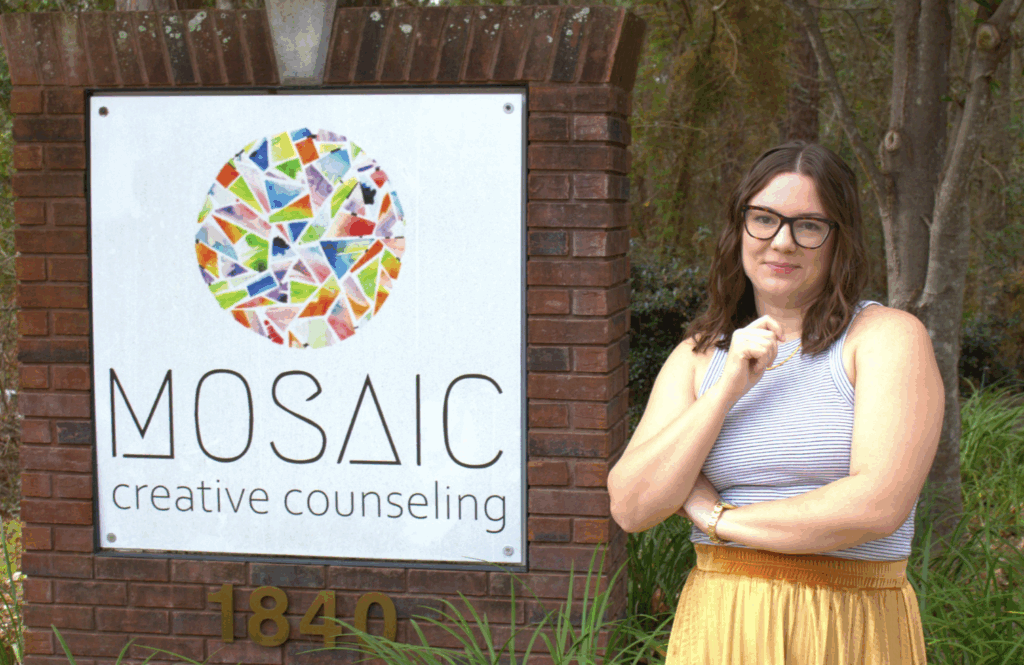
Art therapy alum Nicole Rainey is the founder of Mosaic Creative Counseling.
Nicole Rainey (M.S. ’15), a Licensed Mental Health Counselor and Registered Art Therapist, is a graduate of Florida State University’s art therapy master’s program who has dedicated her career to integrating creativity and clinical care. Through her private practice based in Tallahassee, FL, Mosaic Creative Counseling, she provides individualized therapy services designed to meet clients’ unique emotional and psychological needs. In the following interview, she reflects on her professional journey, the realities of private practice, and the meaningful ways she helps clients find healing and resilience through creative expression.
To begin, Nicole shared a bit about her journey to becoming a Licensed Mental Health Counselor and Registered Art Therapist.
“My whole life, I always enjoyed two things: art and helping people. Growing up, I would go back and forth between “I want to be an art teacher, or a therapist when I grow up.” In my undergraduate career, I majored in studio art and psychology. My original dream vision was to build a large house on beautiful acreage of land for trauma survivors to recover using creative modalities like art, music, nature, yoga, animals, etc. During undergrad, I learned more about the field of art therapy. I knew that was the missing link for me, so I went to FSU’s amazing art therapy program for grad school. I had wonderful internships, classes, professors, and colleagues who helped shape my career journey. After graduation in 2015, I had amazing mentors and supervisors who challenged me, encouraged me and supported me as I pursued licensure for mental health counseling and becoming a registered art therapist. In 2017, after 2 years of post-grad supervision, I became a Licensed Mental Health counselor and Registered Art Therapist.”
Nicole’s time at FSU shaped her, both personally and professionally, by giving her confidence in herself and in the creative process.
“At FSU, I was challenged to research, facilitate, and experience first-hand the healing power of creativity. The curriculum in Art Therapy is driven by research, and students are encouraged to trust the process with clients. Each class also challenges students to engage in their own art therapy process first, so that we can be a field that practices what we preach.”
Nicole’s internship/practicum experiences solidified interest in art therapy.
“In my internships, I got to practice art therapy with many diverse clients. I was lucky enough to have internships in the local schools, prisons, and state hospitals. Helping people actually find healing through art got me hooked on art therapy!”
Her education at FSU gave her the clinical foundation that she needed to feel confident in the therapy room.
“After graduation, I felt confident in working with diverse clients and using art to help people heal. That foundation gave me the ability to pursue more specialized training in trauma modalities like EMDR (Eye Movement Desensitization and Reprocessing), and gave me the motivation to build my own practice.”
Nicole was inspired to open her own private practice after her experiences working in non-profit positions.
“I spent the first 5 years of my career working with sexual abuse and sex trafficking survivors. This was extremely fulfilling. However, these nonprofits repeatedly lost funding for these programs and services. I saw what that did to a community of people who found help, and then had it snatched away because of bureaucracy they couldn’t control. That is when my original dream came back to life, and I decided to open my own practice with many different creative therapies available to our community. I wanted a space that was my own and that no one could take away again because of funding or bureaucracy. I wanted a space that was full of creative healing that wasn’t dictated by insurance requirements, grant wording, or other red tape. I wanted a creative healing space that was truly focused on clients.”
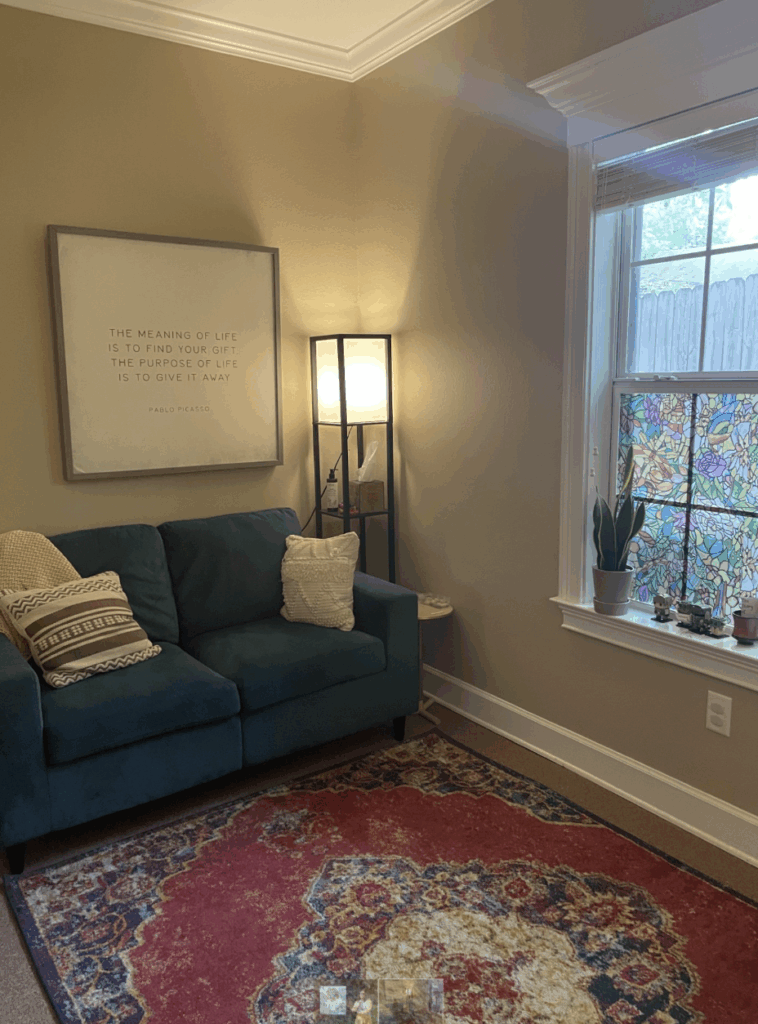
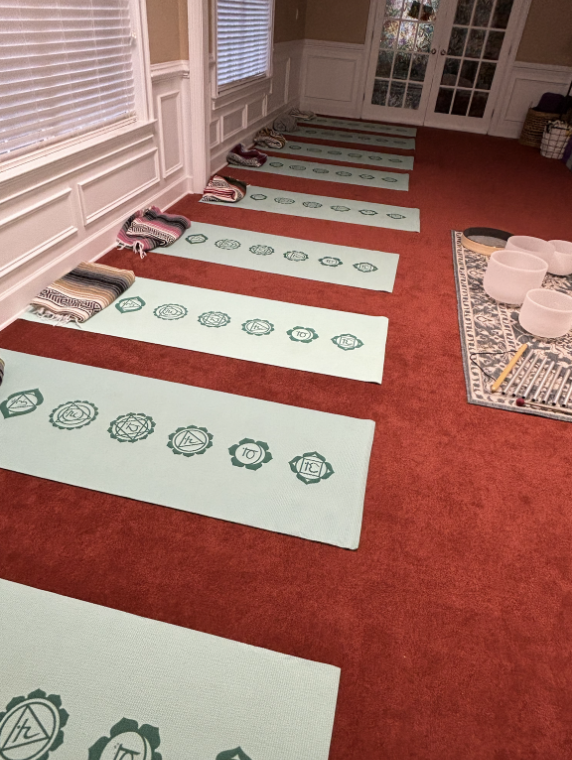
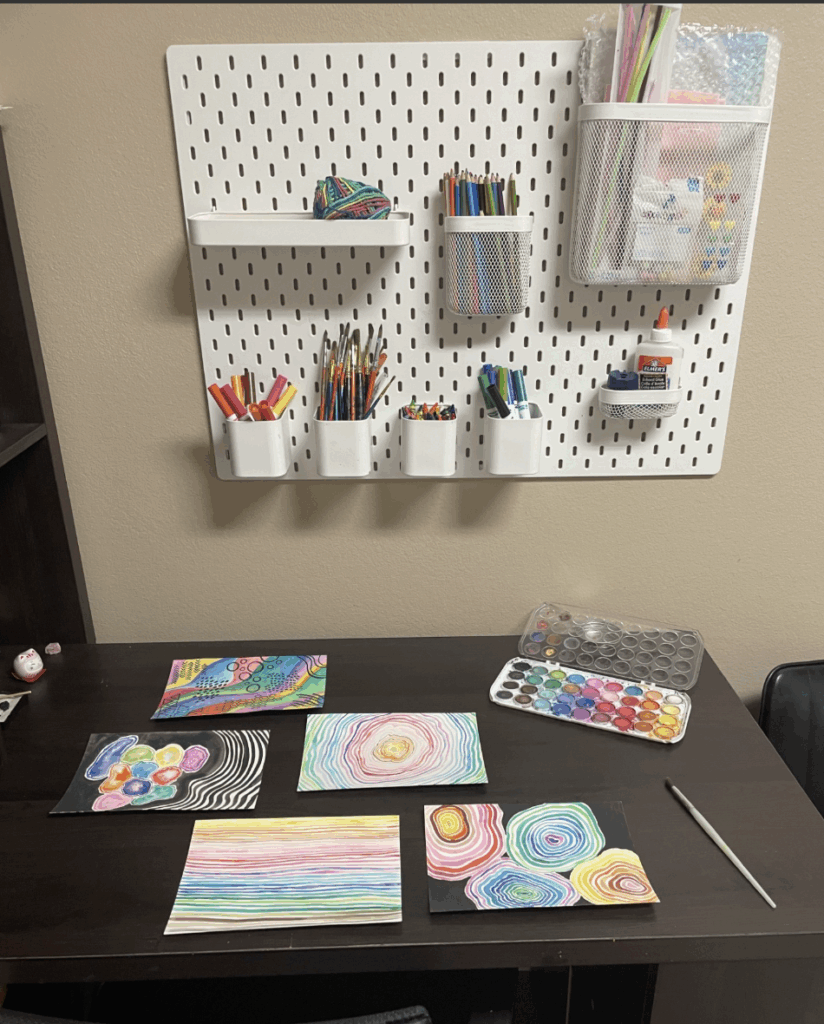
One of the therapy rooms at Mosaic Creative Counseling.Yoga therapy office at Mosaic Creative Counseling.Art Therapy office at Mosaic Creative Counseling.
As a former FSU art therapy master’s student, she shared some advice for current or future FSU students interested in art therapy.
“For anyone interested in pursuing art therapy, I have 2 recommendations: 1. Invest in your own healing work as you enter the field. Therapists often get into this role because we care, but while we hate to hear it, sometimes we have our own unfinished healing. I want to encourage any student who is interested in becoming an art therapist to go to therapy, work on themselves, learn to enforce boundaries, heal their past traumas, build meaningful relationships, and practice their own creative outlets. Do your own work, and you’ll be a great art therapist! 2. Internships and Supervisors have the biggest impact on the kind of therapist you will become. Don’t choose the easy internship, choose the one you’re most interested in, you might even choose the one you’re most afraid of… your internships are the only client experience you’ll get before you’re released into the wild! Choose an internship that will build your confidence, not make for an easy semester. Find a supervisor whom you respect. The feedback your supervisor gives will shape who you become in your career. Don’t just accept free supervision if you are not getting your needs met. Find a supervisor who fits your style, makes you feel challenged and supported, and does the kind of clinical work you want to do one day!”
Nicole provided clarity on the differences between private practice and other therapeutic spaces.
“For the clients, private practice forms a long-lasting relationship with their therapist. When a client works with a therapist who is in private practice, they typically have a relationship with that therapist for as long as they need, often years and sometimes decades! Choosing to work with a private practice therapist gives the client more freedom and control over their healing journey, because administrative staff, leadership boards, and funders are not dictating treatment due to random policies. For example, when I worked in agencies and other therapeutic spaces, I would have clients occasionally show up 15 minutes late to sessions. Well, because of the policies and insurance guidelines, after 15 minutes, that client would be counted as a no-show and be billed for the full session. Now in private practice, if a client is late, I say, “Come on in! Glad you made it!” I once had a client who scheduled a virtual session, but their internet was down (through no fault of their own), and because of the policies, I had to charge them a no-show fee. Now, in private practice, if something similar happened, I could just offer to do a telephone session. What I love most about private practice is that I can truly meet people where they are at.”
Nicole shared what she believes makes Mosaic Creative Counseling unique compared to other therapy practices.
“I believe what makes us unique is our commitment to our 5 core values: Providing accessible and quality therapy services, a diverse team with niche expertise, being a collaborative part of the community, having a growth mindset and vision, and demonstrating creativity and innovation.”
To conclude the interview, Nicole described what excites her most about the future of Mosaic Creative Counseling.
“In a world that is becoming more and more digital, I think the therapy field is at risk of falling into that virtual trap. However, we are already seeing the negative impact of screens, isolation, AI fake therapists, and technology on our nervous system. However, I think Mosaic will offer a unique breath of fresh air by staying rooted in creativity and holistic approaches that take people back into their bodies with movement, creativity, and connection. At Mosaic, therapy and healing have always been about more than sitting still and talking. I am excited to see the endless possible growth of this. I want to see our services and team expand to offer more holistic wellness services like mental health retreats, wellness workshops, community art therapy groups, etc. In a world that is often plugged into a virtual reality, Mosaic is offering a chance to feel alive again through art making, play, yoga, music, animal therapy, and genuine, vulnerable connection.”